Friday, May 20, 2011

San Juan Currents

Too busy having fun;  the adventures are stacking up waiting to be put up for cold winter nights.  I don't THINK it's possible to have too many kayaking adventures, but I may have come close to that point the last month or so.

Catching up in adventure order:  in May I headed back out to Body Boat Blade for their San Juan Currents course.  The course description is ”Learn the skills and strategies for dealing with the powerful currents, tidal races, and over falls that run through the San Juan Islands. We will explore ferry gliding, how to read water, crossing strategies, and how to predict the time, speed, and direction of currents. These are the skills you need to plan an easy, fun, and safe trip. We start by refreshing your skills, and then we enter these races and build your confidence as the currents increase. This is a great class to start building your rough water skills and broaden your knowledge of the sea. Come to this class with play in mind!" Prerequisites are BCU 3 Star Skills, Ocean Currents Class, confident rescue skills and a solid roll.

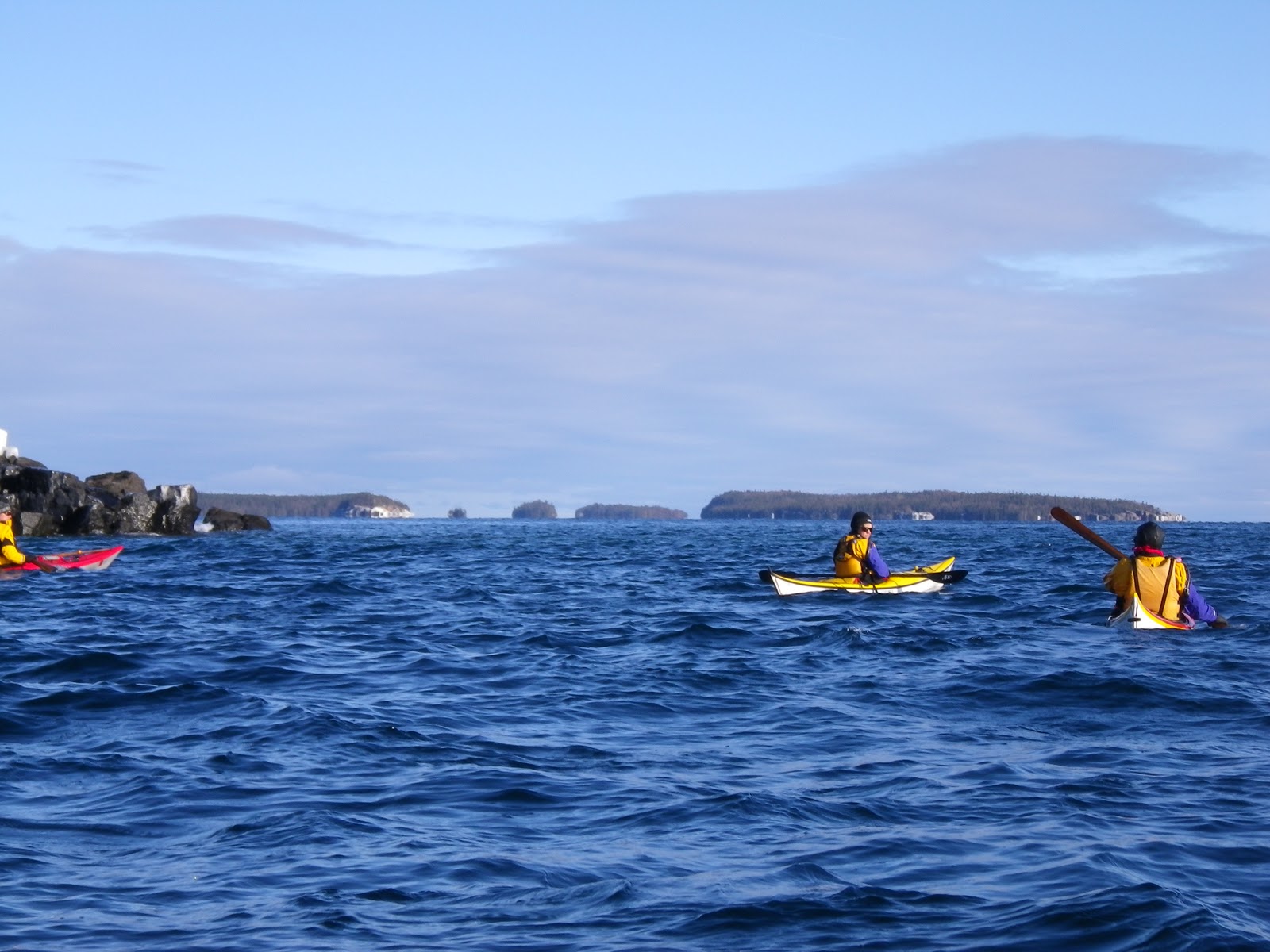
Said differently, the class provided a chance to experience a wide range of the conditions found in the San Juans, with a couple of coaches/5 star paddlers guiding the way and providing a safety net.  Held on May 18 and 19th this year, this course is scheduled to coincide with the maximum tidal range and difference in speed between flood and ebb currents.  All of the varying conditions were available between the southwest corner of Lopez Island and across to San Juan Island.

The adventure began with a little logistical mess up on my part.  I thought I had scheduled a flight at 9:50 AM the day before the class, giving me ample time to get to Seattle, pick up a car, drive up to the ferry in Anacortes, get to Lopez Island, and find the little one room/off season cabin in the woods that I'd rented.  I tried to check in for the flight the night before, and was informed that it was not within 24 hours of my flight.  After a bit of concerned head scratching, I realized that I'd made my reservation for 9:50 PM.  Ooops.  It all worked out, and I got an extra day of work in, but ended up just a wee bit short of sleep.

The six students met Leon and Shawna at Holly B's bakery in Lopez village.  It only seemed polite to buy a bakery treat while we were waiting for all the students to arrive.  Said bakery treat was justified as being for lunch.  It did not survive that long.

Our classmates included 3 young men from Iceland who had met Leon and Shawna during their Iceland circumnavigation in 2003 and were visiting the west coast.

Once we were all gathered we did some on land work, including discussing tidal races, then drove around to Mackaye Harbor on the south end of the island to launch. The plan for Day 1 was to play in the tidal race and standing waves off Davis Point.  Both days of the class proved to be unexpectedly sunny and warm (contrary to the weather reports and prior days' weather).  Clouds and rain would have worked, but the bright sun and blue skies were a treat.

We paddled out to Davis Point as the flood current was building.  This Midwestern paddler was delighted with the purple sea stars clinging to the rocky shores.

The first day's focus was the standing waves.  I proved to be a slow learner.  The green waves (easy to surf) were in the front.  A wave or two back, things quickly turned into a confused mess.  I suppose I gained a certain comfort level in paddling in a confused mess, but it took me quite a while to integrate and act on the idea that instead of thrashing around in the confusion, one should try to stay in the front, and if you drifted back (where the current was taking you), simply paddle over to the eddy and get in front again.

I also worked a lot on my stern draw.  Works okay in calm water; not so reliable on a wave.   Need to get the blade in the water better.  We did some rescues in the rough water.  One person capsized unintentionally and it was impressive how quickly he was carried up the San Juan Channel.  Learned a new paddle signal on that one -- come to me (paddle up), then point to the paddler in the water (receding into the distance).

After lunch and some more play time, we headed back to Mackaye harbor, but the day wasn't done yet.  We stopped on some rocks by a low cliff and landed one at a time, leaving our boat adrift.  After climbing up the cliff, we jumped off, and climbed back in to our boats.  Most of us jumped forward from the low spot.  One of the Iceland guys climbed to the higher spot;  another one did a back flip.

We had dinner together, then off to a good night's sleep.

The next day we started at Holly B's again and discussed a range of topics.  The white board had some points from a prior class, which we discussed briefly (submerge your blade; get your skeleton behind your blade;  keep your blade away from your body;  hook your blade and move your boat past it).  We discussed catastrophe theory (roll in anger!) and the Inner Game of Tennis.  Owning your paddling.  Watch me … I'm going to be great! 

After a while we turned to the day's paddle.  How were folks doing on a scale of 1 to 10?  (If not so good, maybe we'd avoid the max current.)

Our goal for the day was to paddle over to the lighthouse on San Juan Island, doing the one mile crossing  near max flood (over 4 knots).  We had a Plan A, a Plan B, and a Plan C.  Plan A was that we would hit our ferry angle and make it directly to the lighthouse and return to Mackaye Harbor.  Plan B was that we would be carried too far north, but would be able to paddle up in the eddy and still get to the lighthouse and return to Mackaye.  Plan C involved leaving a car at a point farther north in case we couldn't get back to Mackaye Harbor due to the current carrying us north.  Good lesson on real world examples of having backups to your backups.

We played assorted balance games after we launched (jousting, paddling with feet out, turning around on the back deck, down dog yoga, standing in our boats.  (How far up does a paddler have to get to call it "standing"?)  Many swims occurred during this period.

Then we worked on a number of navigation exercises while we waited for max flood.  Set a ferry angle allowing for the current to get that island.  Calculate the course from the chart, allow for variation, and set a range to hold the course to get to that island.  We landed on a little rock while the tide was racing by (Shawna stayed in her boat to catch any stray equipment or paddlers).  Paddling figure eights between rocks in the tidal current.

Eventually it was time to head across to Cattle Point.  We followed Leon, while Shawna nipped at our heels.  There were boils (upwellings or bulges where the water pushes up from the bottom and flows away from the center) and other interesting features in the water.  We missed our Plan A target, but tucked in before Goose Island (Plan B) and paddled most of the way back to the lighthouse.  After a break, we headed back across the channel to Lopez.  Following Leon felt like we were playing crack the whip, as we wound our way across the dynamic water.   It was clear that boat control, ability to paddle in a tight group, and paddling speed/fitness expectations rise with the BCU star levels.

We had several people who had to catch the evening ferry, so we ended up going with Plan C, enhanced by having the one of the Iceland guys who wasn't paddling drive a car up to the Plan C landing site.

After we landed, fetched remaining cars and loaded the boats, my friends of the past two days headed off to catch the evening ferry.  I found a yummy dinner at the Love Dog Café, then it was off to pack and sleep before another early ferry the next morning.  The return from Lopez to Anacortes was beautiful.  It's easy to see how people fall in love with the San Juans.

Photos are here.

Saturday, April 2, 2011

Deception Pass with Body Boat Blade

At the end of March, I was lucky enough to be able to head out to the Seattle area to take a class with Leon and Shawna at Body Boat Blade.  I've been able to paddle in some pretty wonderful places and get some great coaching the past couple years, but that didn't stop me from being pretty excited about this trip.  The Pacific Northwest is a completely different environment than inland lakes or Lake Superior or Georgia.  Shawna and Leon have a reputation as great coaches, and this class would be in Deception Pass, a narrow strait that the tide squeezes through at 5 and 6 knots (sometimes over 8 knots), creating eddy lines and whirlpools and standing waves.  I'd seen video of kayakers in Deception Pass.  It can become a pretty wild place, although it was relatively tame when I was there.

Our class was made up of 6 students in addition to Shawna and Leon.  We gathered at noon at Bowman Bay on Thursday.  We started with some on-land discussion, including getting on the same page with rescues:  let Leon and Shawna handle the rescues, and don't try to help;  that becomes a distraction.  If you go over, flip your boat and move towards the bow but not all the way up.  Transfer to the rescuer's boat.  Don't hand them your paddle until asked.

We ran through their risk assessment method, where you plot potential risks as red, yellow, or green, and make a conscious effort to change the situation to move reds and yellows towards green.  And we were reminded that risk assessment isn't a one time task;  you're doing it all day long.

Max flood that day was about noon, with slack around 3:00 and the max ebb of 6.6 knots just before 6:00.  The day was calm when the group arrived, but by the time we were ready to launch shortly after 1:00, the wind had picked up and there were frequent whitecaps in the bay.

We had to paddle out of the bay and south around the headland to get into the pass.  The waves were decent sized and reflecting off the cliffs of the headland, and we were paddling parallel to them.  At one point I found myself on the side of a wave looking down to my left and thinking "That's a long way down to the bottom of the trough."   An instant later, I was on top of the next wave.

Some of our group were not comfortable in the conditions, so Leon and Shawna decided to forego rounding the headland.  We turned around and paddled back to the bay and portaged across to the pass, which was a short walk. 

The pass itself is a narrow channel with steep, rocky cliffs.  Pass Island conveniently splits the pass in two at the narrowest part, supporting a high bridge with two arches, one on either side the island.   Being there feels much like being on a river with a deep gorge, except that sometimes the current flows one way and sometimes it flows the other way, and sometimes there's no current at all.

We started by paddling around Pass island, after learning that the more islands you circumnavigate, the more likely you are to go to heaven.  Or was it the more islands you get to paddle around after you get to heaven?  I forget.  In any case, the north side of Pass Island was where we would do most of our work (play?) over the next two days. It has good eddy lines when a current is flowing, no matter whether ebb or flood.

I'd taken a couple classes with Geneva Kayak Center last summer on the Menominee River in sea kayaks, learning to handle eddy line crossings and dynamic water.  The eddy lines in Deception Pass seemed bigger/longer and at times were faster, but the skills carried over from the river very well, and I was glad of the prior teaching and experience with Scott and Ryan. 

DP also has whirlpools.  I'd seen them on the video and asked about them at the beginning of the class.  No, they don't suck you down.  (At least not this size.)  Good to know.  It is, however, a good idea to pick which side you paddle across them on, as they can slingshot you forward or pull you in towards the center.

Conditions changed constantly as the current moved from flood to slack to ebb over the course of the day.  We got some nice standing waves as the swells coming in from the west ran into the ebbing current heading out in the afternoon.  When we paddled back around the headland at the end of the day, there was a beautiful seascape of waves and breaking waves off in the distance.

Friday was rainy and we started much earlier (8:30) to catch beginning of the flood current.  Our first assignment was to launch some way we didn't normally launch.  Leon had showed me a speed launch the previous day (bow in the water, grab the stern toggle, run the boat into the water and launch yourself belly first onto the back deck, then cowboy up into the cockpit.).  First time I tried it I went for a swim, but by the end of the class, it was working pretty well.

After a backwards paddling warmup, we headed over to a dock that was a couple feet high.  We got out and pulled our boats up and across the dock, then shoved them over the other side and jumped in after them (holding onto them the whole time), and re-entered from the water.  (Much easier to do a cowboy re-entry if you start horizontal on the water, not vertical.  Thank you, Leon.)

After paddling around the headland, the next destination was the Room of Doom.  This is an area on the far side of the pass, just to the left of the bridge pier.  There's a back eddy there during a flood current, with a sharp eddy line and whirlpools and boils.  (Throughout the class, Leon kept wanting to lead us to the Valley of Sunshine, or so he claimed.  Shawna was more apt to take us to places like the Room of Doom.  Should we make that mean something?)

Shawna had asked me to lead the group over across the pass.  After a period of trial and error and some helpful leading questions from Shawna, I stumbled across the idea that if I was to one side of the group,  I could see everyone without craning my neck, and set a pace that was good for the group.

In an example of how our minds play tricks on us (or at least mine does), the Room of Doom had originally been described to me as "behind the bridge pier."  (Or at least that's what I heard.)  Perhaps because I knew that Shawna and Leon had once been at the University of Minnesota, the image that I created in my mind was based on the the I 94 and Franklin Avenue bridge piers on the Mississippi, and I expected the Room of Doom to be between the pier and the shore.  I kept looking for the openings on either side of the pier that would allow us to get behind it.  This was despite the fact that we had paddled by the Room on the previous day, and the fact that it was pretty obvious that the pier was solidly on land as we approached it.  Sigh.

As with the Pass itself, the Room was fairly mellow that day.  It was fun to play in, but fortunately didn't live up to its name.

Back at our now familiar playground by Pass Island, Shawna started throwing tennis balls out into the current for us to rescue. Next came rescuing each other.  The plan was for the first person to paddle out across the eddy line, and capsize as soon as we were in the green (smooth) water in the main current.  Our partner would be right behind us and come up for a T rescue. 

I jumped the gun and capsized and exited a little too close to the eddy line.  A couple seconds later I was in a whirlpool.  Boat was going one way and I was going another.  I remember ducking under it and switching sides, and then I was out and back in the main current.  Interesting experience.

We also did self rescues out in the current, and learned other assorted new tricks, including a dynamic leg drop for edging our boats. At one point I was supposed to be watching Leon show me something to try next, and a seal popped its head up right behind Leon.  I watched the seal.  Sorry, Leon.

By mid afternoon folks were running out of gas and the flood was nearly done, so we headed back around the headland.  We found a narrow V in the cliff and took turns moving up to it and paddling forward and back to hold position as we were washed up and down and in and out by the swells.  My initial concern was the image of getting my (borrowed) bow caught on the rocks at the top of a swell as the water drained away beneath me, but Leon helpfully pointed out the possibility of getting the bow stuck at the bottom as the water surged up.   Good reasons not to get stuck.

We had an early dinner at the Deception Pass Café, and called it a day.  Great two days, and a great warmup for the San Juan Currents class in May.

Photos are here.

Saturday, March 12, 2011

Kayak Camp with Ben and John

When I told people I was going south at the beginning of March, there were some assumptions about what I would be doing.  Walks on the beach.  Swimming pools.  Relaxing.  Adult beverages.  Dining out.  Sleeping in.  

When I explained I was going to Ben Lawry's kayak camp, I got a range of responses.  Polite puzzlement was fairly common from my non-kayaking friends.  I think that even of a few of my kayaking friends may have thought this was a little over the top. 

But for me, it was perfect.  Four days packed full of learning and fun with two terrific coaches.  Eight similarly kayaking-obsessed participants who quickly became friends.  Water that wasn't frozen solid.  A color palette that wasn't black, gray and white.  A great start to the paddling season in terms of getting into shape and getting focused on areas to develop.  

We gathered in Tybee, GA on Thursday night.  The other participants were from Nova Scotia, New Jersey, Virginia, South Carolina, and New York.  The coaches were Ben Lawry and John Carmody.  Ben and John are aligned in coaching philosophy, but not identical.  They complemented each other very well, not only in terms of facial hair and height, but also in terms of communication style and approach.  If you get a chance to work with either of them, grab it.

Kayak camp has no set agenda.  On the first night, the group comes up with goals.  Over the next four days, the coaches work with the conditions and the goals to deliver the best learning opportunities possible.  Each night we had a chance to revisit our goals in light of what we had done that day.

Day One was very windy with confused seas and most of us hadn't been on the water for months, so we headed to an inland lake to work on core skills.  Lots of edging.  Paddling with eyes closed.  Theory of turning the boat in wind.  Paddling on one side.  It always amazes me how much there is to learn about basic skills.  And warm ups on all 4 days were always a treat, as we coaxed our somewhat older than 40-something bodies into motion.  (Where does Ben think these things up?  Frogs and crabs and cats and dogs and paddles and twists…?)

Day Two was windy again, and we launched on the south channel of the Savannah River and headed east, an area of Tybee I'd never visited.  Paddling with ranges, starting to work with currents, navigation, surf landings, trip leadership, rescues, a visit out to Cockspur Lighthouse.

Day Three started on the dining room table with a discussion of currents while we waited for a cold front to pass through, then we worked on taking advantage of the currents and spinning on the eddy lines of the back channels.  Hip snaps on paddle floats.  Towing.  More navigation.

Day Four was more trip leadership and piloting, as we took turns leading the group through Jack's Cut around Little Tybee.  Funny thing how when you're piloting, you need to pay attention for more than the first five minutes.


We stopped for lunch, after which Ben drew a series of diagrams in the sand and we paired up to explain them.  Then a bit of surf practice.  Use your balance, not your paddle to stay upright.  If you're going to crash, crash big.

Then it was over, and how did it end so quickly?  We had a group debrief, then met one at a time with John and Ben to get some feedback on things to keep practicing.  Then dinner, and crash, and the next morning headed for home.

What made the camp so special?  A shared philosophy that it was better to learn it right than jump ahead on shaky foundations.  (Better to learn to surf well on baby waves than to survive on 3 foot waves without knowing what you're doing.)  Being able to devote the time that each different topic needed, and keep revisiting things over the four days to take them deeper and understand them better and look at them in different contexts.  Superb coaches, and a great ratio of coaches to students, so there was regular feedback.  Everything was taught with an enormous amount of inventiveness and creativity and fun and enthusiasm.   We all had a chance to help each other.  Wonderful organization from Elizabeth (Ben's wife), as well as some great cooking that was much appreciated after long days.  Pelicans and gulls and the whole seascape that's such a treat to a Midwesterner, especially when the snow drifts at home were still over my head in places.  

Gosh darn it, we may all be suffering from a big fat mid life crisis, but who cares.  This kayaking stuff sure is fun.

Photos are here.

Tuesday, November 30, 2010

Clean the House or One Last Paddle?

Friends were getting together up in Grand Marais over Thanksgiving weekend and I was invited to join them. 

I'd been looking forward to spending Thanksgiving with my family, and after that had been making virtuous and productive plans for the rest of the long weekend, most of which were variations on the theme of getting caught up with just about everything after a self indulgent spring, summer and fall of paddling.   Cleaning the house was a prominent item on the to do list.  But if you dangle a chance to go kayaking in front of me, I have a hard time turning it down.  And hanging out with good friends is always a treat.  So it wasn't long before the house cleaning was blown off and the departure planning was underway.

Tony and I ended up driving up together on Friday morning, and we both felt just a wee bit silly loading up our boats with the temperature in the teens, snow on the ground, and ice on the lakes.   Just in case the weather precluded paddling, we also packed up cross country skis and snow shoes, which ended up making us feel even more foolish when we looked at the sheer volume of gear we had along.  But ... in for a penny, in for a pound, and we were soon headed north.

In Duluth, Tony introduced me to the Lake Avenue Café, a little restaurant in Canal Park with an inventive menu ranging from pulled bison to falafel to pheasant and rabbit ravioli.  It was vastly better fare than McDonalds or Subway.

We arrived in Grand Marais late Friday afternoon, just as Jeff and David were heading out for a paddle in the harbor.  Tempting though it was to join them, there just wasn't enough daylight left, so we saw them off, then unloaded our gear and settled in to our respective lodgings.  Post paddling and unpacking, all of us gathered in the townhouse and enjoyed a second round of Thanksgiving dinner with leftovers from Michelle's feast from the previous day. 

Saturday's weather forecast was looking likely for kayaking, so after dinner the discussion turned to where.  A suggestion was made that we drive up the Gunflint Trail to Lake Saganaga.   We discussed it, but with the early winter sunset limiting our daylight, an additional 120 miles of driving, and ice along the shore that would be a bit of challenge to launch on and an even greater challenge to land on, we decided that it wasn't feasible on this visit. 

This time we decided we would stay on Lake Superior and head to the Susie Islands, an archipelago a few miles from Grand Portage, just south of the Canadian border.  Susie Island is the largest of the islands and is owned by the Nature Conservancy.  The remaining dozen islands are owned by the Grand Portage Band of Ojibwe.  Landing on the islands is prohibited without prior permission from the respective owners. 

The Nature Conservancy website describes the Susies as "both young and old. The bedrock is slightly metamorphosed sedimentary rock, deposited in a sea over one billion years ago. These rocks were later intruded by molten magma to form resistant dikes. Glaciers of the Great Ice Age scoured the rocks many times over the last two million years, but the Susie Islands only emerged about 5,000 years ago.

"In this isolation, a pioneering community of plants continues to thrive. Species that disappeared from the rest of Minnesota after the glaciers receded northward still survive here. Today, many of these plants are more typically found in Arctic and sub-Arctic regions."

On Saturday the weather cooperated with our plans, with sun and a temperature in the 20s.  We drove up to Grand Portage and started looking for a launch site.  Ice coated rocky shores and roads that were either closed or ice covered limited our options and reminded us that winter paddling requires more than just open water. 

We finally found a viable place to launch from, and it was about 12:30 when we got on the water.   Round trip around the outside of the Susies is a little under 15 miles, and sunset would be about 4:15.  We decided to paddle out until 2:00 and return, however far we'd gotten at that point.

We paddled northeast towards Hat Point.  I initially thought the white stuff atop the rocks was guano, but then realized it was bright white ice.  The waves from the high winds of the previous few days must have crashed on the rocky shore, creating "flung spray and blown spume" that built up and froze into a brilliant white coating on the rocks and trees and grasses.

The Susies came into view as we rounded Hat Point.  The featureless two dimensional green blobs on the map became intriguing islands of varying sizes and shapes.  A couple of rock outcroppings and small cliffs were coated in the same white ice as the mainland and were highlighted by the sun behind us.   The most distant island seemed to be floating free atop the lake surface.

But alas, as our turnaround time approached, it became clear that we weren't going to make the Susies this time.  We reluctantly turned around and headed back to pay our respects to the Witch Tree.  This iconic cyprus clinging to solid rock is sacred to the Ojibwe, who name it the Spirit Little Cedar Tree. Small and gnarled, the tree stands alone between the lake and the cliffs.  It was first mentioned in historical documents in 1731, and was a mature tree at that time, making it at least 300 years old.  Seeing it on a quiet afternoon, it was hard to imagine the violent storms and bitter cold it has seen and endured.  Respect is indeed due to this survivor, holding fast against the odds.

Then we paddled back around Hat Point, past Grand Portage Island, and back to our launch site.  We landed well before dark and loaded up the boats to return to Grand Marais. 

It was a fitting final paddle of the year.  The chill in the air, the low sun and its faded light, and the snow and ice starting to claim their sovereignty over the land were all signs that winter had arrived.  Getting to the Susies and Sag will have to wait for next year, but it was a treat to have one last chance to appreciate the lake with my friends. 

On Sunday we headed for home, with a stop for a short hike in Split Rock state park.

And the house cleaning did just fine waiting one more week.

Thursday, November 4, 2010

What a Difference A Year Makes

Last year I went to the BCU week/Skills Symposium at Sea Kayak Georgia and had a great time and learned a lot.  But I really hadn't had much experience in big water, and it showed – I was able to paddle in the bigger conditions, but it was a bit forced.  And skills that I'd only been working on for a year were decent, but there were definitely some rough spots.

This year everything was easier.  Did the 3 star assessment the first day with Lamar Hudgens and another candidate and it went well.  The main feedback was more edging in the surf and conditions, which I worked on the rest of the week.  And a good comment:  a good trip leader doesn't get the group out of trouble;  he/she keeps the group from getting into trouble in the first place.

Day 2 was Rescues and Incident Management with Jeff Allen.  Great teacher, nice guy.  The course could have been a 5 day course (and is in Cornwall), and was packed with information.  Lots of acronyms: CLAP (communication, line of sight, avoidance, position), HEET (Human, Equipment, Environmental, Time), SAFE-R  (Stop, assess, formulate a plan, execute the plan, re-evaluate).  Leading from the front, looking back.  Shepherding and linked chains.  Learning one rescue method that always works, and doing it fast from any position, since you may only have a small window of time to get someone out of there.  Some good towing tips.  The difference between a casualty (someone who is actively involved in the rescue) and a victim (someone who is not).  Jeff F. and another paddler were going for 4 star so they were our leaders;  the rest of us had fun being victims and casualties.  Note to self:  never again get so carried away in the role of being a victim and throw expensive paddle away in front of the surf.  (Fortunately, Brad retrieved it.)  


Jeff F. was shepherding someone in through the surf and she capsized and came out of her boat (not a drill).  Jeff pulled up to do a rescue and her tow rope had come out of the bag and was wrapped twice around the boat.  Like they keep saying:  ropes in surf are dangerous.

But as Jeff Allen reminded us, the sea isn't cruel or out to get us, it just is. 

Day 3 was with Gordon Brown.  Funny how you need to learn things more than once.  I know I've heard "when turning in high wind from a beam to the wind position, paddle on the downwind side – forward sweep to turn upwind, reverse sweep to turn downwind" before, but it hadn't sunk in until this time.  


I bailed after one capsize and tried to do a cowboy re-entry;  it didn't work, and afterward Gordon reminded me about staying low and keeping legs and arms out.  You can get away with things in flat water that you can't get away with in the surf.  We also heard there was one dislocated shoulder that day in another class.

Day 4 was with Hadas Feldman, working on linking strokes.  And of course edging.  At the end of the course, everyone did a "dance" with their boat (extra points of you could narrate it;  I did not), and then we paddled back along the edge of the marsh, using our newly learned stroke combinations to hug the shoreline as it wound about.

Day 5 was Intermediate Surf with Dale Williams and Tom Bergh.  I'd gotten a few good rides in Gordon's class, but they felt like blind dumb luck.   During the surf class, I had a breakthrough in feeling comfortable in the surf.  It wasn't huge surf – probably 4 footers, but it was great fun.  Dale reminded us that we can have influence in the surf, but we can never control it.  I tried surfing backwards -- it was interesting to see what's going on on the wave side of the boat.  Learned that in the surf, you edge towards the direction you want to turn, not away (no wonder edging never worked to turn my boat before).  I'm still a newbie and have lots to learn in the surf, but definitely making progress.

And of course all the rest of the week was great too.  Good friends, good weather, seeing folks that I'd met before, making new friends.  Sometimes on the water I'd just sit there for a few minutes and soak in the pure enjoyment of being on the sea, riding the swells, watching flights of pelicans wing their way across the water and flocks of gulls wheel and turn, spotting the occasional dolphin.  Starting to read the surf and tides better.

The week gave me some great feedback on how much I've learned, but it also opened up how much more there is to learn.  4 star once seemed completely inaccessible.  Now it seems like a lot of work, but within the realm of the achievable.  Definitely ready to take the next step and see where it goes.

Wednesday, October 6, 2010

GKC L4 Weekend: Train High, Assess Low


Train high, assess low was the theme of the Level 4 – Open Water Sea Kayak Training weekend with Geneva Kayak Center last weekend.  The plan was to spend one day on the Menominee River working on skills in moving water (crossing eddy lines, etc.), and two days on Lake Superior working on open water coastal kayaking and leadership skills.  Conditions in both venues "over delivered". 

Jeff and I traveled together.  We showed up bright and early on Friday morning at Piers Gorge on the Menominee River.  Ryan and Paul were the instructors;  Sarah and Mary were our fellow students, with Aaron joining us on Saturday 

The water had been around 1000 CFS when I'd been there in early June;  now it was around 3000 CFS (based on USGS info).  As Ryan said, it was "kind of pushy."  According to the Wisconsin Paddle Guide, Piers Gorge "is a high adrenaline action run that features Missicot Falls in Piers Gorge, a class 4+ drop that should only be attempted by advanced and expert kayakers, or on a guided rafting trip. The run through Piers Gorge is comparable to many of the big action rivers out west, though it may not have the huge drops, the sheer volume and velocity of the water flow raises the hazard level considerably."  It goes on to say "Kayakers should not attempt at high water levels. When river levels rise above 3000 cfs, some of the holes below Missicot Falls become quite powerful and have been known to "de-boat" paddlers into an unpleasant half mile swim."  More on that later.

On Friday, we spent the day at "Terminal Surfer", if I got the name right.  We were at the bottom end of the rapids and worked on the eddy lines.   In June we had few or no capsizes;  this time they were pretty regular.  We learned to be much more aggressive at getting to capsized boats for rescues, and how to roll in the bumpy water (interesting to find your set up position when the surface is uneven and constantly moving.)   Having the swimmer flip their boat and move to the bow was a big help in getting our rescue times down.

While we were on our lunch break, Jeff and I both had our keys and key fobs sitting in the car while we were getting our stuff out, and one of the "lock car" buttons must have gotten accidentally pushed, because when we closed the doors, the car locked itself.  Our great trip mates had an AAA card (I'm a member, but didn't have my card with me), a cell phone (Jeff's and mine were in the car) and a GPS unit, and AAA came through with a free unlock service.   Wish I could go back to a regular, non-chipset key!

At the end of the day on Friday we drove up to Marquette, MI.  The forecast for Saturday was "North winds to 25 knots, waves 7 – 11 feet."  That would exceed Level 4 conditions, which are 3 – 5 foot seas, 15 – 20 knots of wind.   Clearly we had no worries about lack of conditions.

Dinner was at L'Attitude, which we closed down about 8:30.

Saturday morning it was clear that the forecast was spot on.  Our planned launch site had steady lines of surf across the entire beach.  We headed over to a marina and a protected boat launch.  As we paddled out towards the breakwater, we could see the spray from the waves on the far side flying up 20 feet and more.  Ryan and Paul paddled around the breakwater to check things out, but decided the winds were pretty high for making any progress, so we proceeded to paddle for about a mile down wind/down wave towards the beach.  Jeff and Aaron were our trip leaders (since this was a leadership class).  The waves were definitely bigger than anything I'd been on before, but it was all doable.  Ryan went in first to land folks with paddle signals.  I followed him in, and surfed in to a gentle landing.  Learnings on that beach:  let the big sets go by, and surf in on a small wave.  The big waves were about 6 feet on a fairly steep beach and not really surfable.

When everyone had landed, we were supposed to work on surf launches and landings.  Most of us did not do well on that exercise.  I never got off the beach.  Need to be more aggressive. 

Next up was paddling over to a group of islands that would provide some protection from the open waves and give us a place to work.  Sarah and I were trip leaders for this stretch. We carried the boats down the beach to where the surf was a bit less exciting.  The plan was to have people wait out in "the gathering zone" after they launched until the entire group was on the water, but it quickly became apparent that this provided its own set of challenges in big conditions, as the paddlers who launched first had to hold position in the high wind and big waves.  Once you start launching your group, the faster you can get everyone launched, the better.

Once on the water, we headed for the islands and Sarah and I scouted for the best place to land.  Did I mention that there was no beach on the islands?  We ended up paddling to the lee side of one of the islands, getting out in the water, and hauling the boats up onto the rocks.  Then we happily settled down for lunch.

After 10 minutes or so, Jeff said "I hear a fire engine."  Soon it came into sight, and pulled into the park on the shore about 300 yards across from the island.  We wondered what was going on.  Then another engine showed up, then one or two more emergency vehicles and even a TV truck.  We were beginning to wonder if we could possibly be the objects of all this attention, and when the Coast Guard boat came around the point from Marquette, we realized we must be.  Ryan launched to have a chat with them.  The Coast Guard must have called the fire folks on their radio after that, because the fire and TV trucks left moments later. 

After lunch, we did some rescues on the far side of the island (out of sight of shore!), where there was an area partially surrounded by other islands.  It was protected from the full open water, but still pretty bouncy as the water surged about.  One of the big learnings was situational awareness for a leader … keeping your group away from hazards and tucked into calm areas whenever possible.

Our final exercise was for Sarah, Mary and me to tow "injured" Jeff and Aaron (rafted up) through the surf and land them.  I'd never done such a thing, but our initial attempt was to have Sarah and Mary in an in line tandem tow and me as the drogue paddler.  Mary's rope (borrowed) turned out to be too short to be safe, so we tried to reconfigure … I moved up to the lead position.  But by then we had drifted too far and were in conditions and we called off the exercise and debriefed on shore. The consensus was that a) two inline paddlers and a drogue paddler were too big a connected system in this situation and b) a single tow-er would have been plenty given the short distance and gentle surf on this beach and c) coming in at an angle to the surf would have eliminated the need for a drogue paddler. 

Tonight dinner was at Coco's, with live music from a couple of singers/guitar players.  It dates both the performers and me to say that I knew all the songs.

On Sunday, Lake Superior had done a presto chango, and there were no conditions to play in.  We decided to head back to the Menominee River.  We launched from the top of the gorge this time.  We paddled down to the island and picked our way down the first set of rough water into an eddy, then down about half a mile where we landed for lunch.  Ryan took one of the boats and ran the drop, then walked back up to join us.  After lunch, those who wanted to had a chance to run the drop.  Mary, Jeff and I carried our boats down and settled in to watch and video.  Soon Aaron appeared, and was over and out of his boat before the drop.  Paul did the same thing.  Then Ryan and Sarah appeared.  Sarah also capsized before the drop and Ryan tried to rescue her, but she too came out of her boat.  They both went over the edge;  Sarah went into the hole but came out quickly (holding onto your boat is a good thing!)  Ryan capsized as he went over the drop, but rolled. 

Net score:  4 paddlers capsized, 3 came out their boats, 2 paddles lost.

Jeff, Mary and I paddled down to join the others.  We played a bit at Terminal Surfer, but all were ready to call it a day before long. 

All in all, a great weekend with good folks and another step in the kayaking journey.

Friday, July 16, 2010

Silver Islet to Rossport


Just got back from paddling from Silver Islet to Rossport with 5 friends.  Our route was about 80 miles along the northern shore of Lake Superior in Ontario. It's a well known kayaking destination among Lake Superior paddlers, though perhaps not so well known to paddlers farther afield.  Numerous islands along the route add interest and variety, as well as providing safe harbors and options for finding protected water in different wind conditions.  The islands and peninsulas are mostly undeveloped crown land.  

Six of us met up in Grand Marais and then transferred boats, trailer, people and gear to Dave's truck for the last stretch of the trip so that we would only have to pay to shuttle one vehicle from our launch point to Rossport.   At Canadian customs, the border officer examined our passports and asked routine questions.  Then he said "The only one I have any concerns about is Jeffrey."  Long pause.  "His birthday is next Saturday."  Border officer humor?

We stayed at the Grann Motel in Pass Lake on Friday night, met Alfred, the proprietor and master of dry humor, and enjoyed two meals of splendid truck stop food before leaving the next morning. 

Day 1:  The final leg of our land journey took us down
the Sibley Peninsula to our launch point in the town of Silver Islet.  It seemed like a sleepy town … mostly vacation homes these days, and the restored general store didn't open until noon.  A few people launched motor boats and went fishing while we were loading up our boats.  

Silver Islet is also the name of a small island just offshore, where a vein of almost pure silver was "found" in 1868 (the Ojibwe had known of the silver all along).  A lucrative commercial mining operation ensued, and a great deal of engineering effort went into holding back the lake waters as they dug deeper and deeper, ultimately over 1,100 feet down.   Pumps kept the mine from flooding until year that the expected shipment of coal to fuel the pumps failed to arrive before winter closed in.  When the coal ran out and the pumps stopped in 1884, the mine flooded and was never re-opened.  

The only other kayaker we saw the entire trip landed while we were getting ready and introduced himself as Glen Smith from Saskatchewan.  He was paddling along the watershed from Alberta east in stages.  This year he was going from Thunder Bay to Sault Ste. Marie on the east side of Lake Superior.  He had left from Thunder Bay the previous day and was stopping to use the phone at the general store.


We set off around 10:00, and paddled east along the southern tip of the peninsula, then had a 4 mile crossing to Porphyry Island.  Looking behind us, the Sleeping Giant shape of the mesas on the land mass became apparent as we gained the perspective of a few miles.  One of the stories is that the giant form lying on his back is Nanabijou, the Ojibwe spirit who was turned to stone when the secret of the silver mine was disclosed to white men.

To our right across the lake to the south we could see Isle Royale, and in the far southeast the Porcupine Mountains in Michigan.  Ahead of us was the lighthouse on the southern tip of Porphyry.  We headed north of Hardscrabble Island to paddle between Porphyry and Edward Islands.  The weather couldn't have been better, and we enjoyed the blue skies, the rock formations, the boreal forests, and the calm water. 

After lunch we paddled on to Magnet Island and continued north, with a tail wind behind us.  We stopped at a campsite on an island east of the Black Bay peninsula where Jeff and Michelle had camped previously.  In a vivid example of how much and how quickly the lake can change its surroundings, the large beach had washed away, leaving a much smaller scrap of beach to camp in.  It was getting close to 3:00 in the afternoon, and we listened to the weather and discussed how to proceed. If the winds from the south picked up as forecasted, the low site on the southern end of the island was exposed.  If we continued north, we would eventually find a campsite big enough to pitch 5 tents, but there was no guarantee how soon.  Most of the islands we had passed had rocky shores, and we hadn't seen many cobble and gravel beaches so far (though they appeared to be more common as we continued north).  The next known campsite we were absolutely sure of finding was Swede Island, 8 nautical miles away.

We finally decided to backtrack to a small cove on Magnet Island, which would provide more protection from the wind.  As was typical, the site was a narrow beach, backed by forest.  There were fairly fresh moose tracks along the shore, birds calling from the woods, and a few mergansers swimming along the shore.  Looking out from the little bay, we could see the Number 10 light house, where we would head the next day.

Tony's boat valets must have gotten his order confused, because they didn't show up that night or any other night.  But we managed to set up camp without them, followed by happy hour, dinner, slingshot games, and finding Wilson, after which we turned in.  That far north and on the western edge of the eastern time zone, it was light until after 10:00, but that proved no barrier to falling sleep. 

Day 2:  In the morning I managed to lose one of my contact lenses, which probably wasn't a bad thing, as switching to glasses simplified the morning routine immensely.  Once underway, we headed towards the lighthouse on Number 10 Island, west of Shaganash Island.  The weather was good, though there were some interesting swells coming from the south.  Farther to the south were some dark storm clouds that we watched closely as we started a two mile crossing, but they didn't come our way.

We landed on Number 10 and explored.  The lighthouse itself was locked so we couldn't go inside, but there was a foundation from a house nearby that might have been the keeper's home.  There were plenty of campsite options in the vicinity.

We continued northeast to Swede Island, home of the famous sauna.  Roger Bailey and friends had built a cabin, sauna, picnic table, outhouse, and dock on the island in the 1960s.  The cabin had burned in the 1970s and had been rebuilt.  It was aging, but functional.  We decided to stop for the evening, even though it was still early.  

Wilson had come along with us from Magnet Island, and we found a companion for him under the cabin after we set up camp, whom we named Harriet.

There was a log book with several years of visitor entries, including previous ISK trips.  Tony updated it with an entry for our group.  Glen, the paddler we had met in Silver Islet, had stopped in earlier that day, signed the log, and continued on. There seemed to be fewer than a dozen log entries each year.  And as the days passed, we were surprised at just how few people traveled the area, having seen only a handful of sailboats, cruisers, and fishing boats. 

After dinner we discussed our route and destination for the next day.  Jeff had hoped to explore Sheesheeb Bay, about 4 nautical miles deep.  We were about 55 nautical miles from our destination at that point, having backtracked to camp the first night and stopped early to take advantage of the Swede Island camp and sauna the second night.  We wanted to be landing in Rossport by Saturday morning, and the group agreed that we would like to be in the vicinity of the Rossport by Thursday night.  If all went well, we would paddle around the Ross islands on Friday.  It was now Sunday night, so allowing for sightseeing, we needed to travel about 15 nautical miles each of the next 4 days;  more if we wanted to allow for a wind day.

Adding 10 nautical miles to get to Shesheeb Bay seemed like a long detour, and the group eventually agreed to plan a long day the next day and try to get to CPR Slip on St. Ignace, 25 statute miles away.  The slip is a former executive retreat, and trip members who had been there on previous visits told of well built facilities open to all and a friendly camaraderie among the power boaters and kayakers who stayed there.

Next up that evening was a sauna for the guys, while Michelle and I watched the evening darken and the sun set from the beach on the other side of the camp. 

Day 3:  In the morning (another beautiful day) we paddled northeast between Spain and Borden islands, spotting the sauna on the east side of Spain.  Farther along we passed some mine ruins.  Eventually a channel opened out into Loon Harbor, which has the appearance of a lake bounded by Spain, Borden, and Lasher Islands.  We spotted an otter, and listened to a very vocal loon in the protected water.  The last time Jeff and Michelle had been here, it had been foggy and quite mystical, in contrast to the calm water and sparkling sunlight we enjoyed this time.

Heading north out of Loon harbor, we continued up the channel past Pugsley and Coutlee Islands, stopping on the north point of Broudeur Island for a break.  There was a huge variety of geology and rock formations on the different islands, and looking down into the clear water near a shoreline was almost as interesting as looking up at the rocky shores. 

Once again we had a tailwind and swells coming from the stern as we got out into the open water, and we made steady progress to St. Ignace, though it was a long day.  We could see the Canadian flag flying as we approached the bay where CPR Slip was located, and turned the corner into the protected harbor to see 2 big power cruisers at a well built, well maintained dock.  There were several buildings, in much better shape than those on Swede Island.   We landed and Jeff walked up to the folks who were sitting around a table, enjoying wine and other treats.  No plastic mugs or tin cups for this group … it was crystal stemware all around.

Nobody had gotten up to acknowledge us other than the dog.  I didn't hear the entire conversation, but there was a discussion of the site being open to all except for outfitters.  We told them we were a private group, and one of the folks asked "is that what they tell you to say?"  It quickly became apparent that we weren't welcome.  Did they really think we were with an outfitter and lying about it?  Did they not like our looks, all geared up with knives and assorted goofy hats?  Were we simply not their kind of people?  Who knows.

We ended up paddling over to Agate Island and camping on the northern shore, where we had both eastern and western sun and a far more pleasant campsite than if we had stayed at CPR Slip.  There was a nagging feeling that we should have stayed at the slip on principle, since the sauna was advertised as open to all, but it wouldn't have been a congenial evening.  We enjoyed our own private little corner of paradise while we ate dinner and watched the sun set.  In the calm water of the evening, we saw the lake rise and fall by 2-3 inches due to small seiches, covering and uncovering a small rock just off shore several times.  After dinner we discussed the next day's route, and decided to make for McCay Cove, another improved campsite with a picnic table and tent platform.  As we had come to expect, loons called across the lake as we fell asleep.

Day 4:  In the morning we paddled to Bowman Island, where there's an old fishing camp and also the grave of Thomas Lamphier.  He was the second of three lighthouse keepers on Talbot Island who died in the course of their duties.  Thomas and his wife were spending the winter on the island in 1869 when he fell ill and died.  His wife couldn't get off the island, and couldn't even bury his body on the solid rock.  In the spring, she flagged down a passing boat and they brought his body to Bowman and buried it.  The story goes that the wife's black hair turned white that winter.  The white cross that currently marks the grave, using the spelling Lampshire, was placed more recently.

Leaving Bowman, we crossed to Armour Harbor.  This brought us within the territory of Nirivia.  A group of folks had declared the 40 plus islands in Nipigon Bay to be a sovereign nation in 1979.  It was not so much a militant assertion of statehood as a means of drawing attention to the pristine nature of this area and the need to protect it.  There were no full time residents, but over the years some docks, cabins, and saunas were built, and visitors were invited to come and stay and appreciate the natural beauty of the place.  The latest edition of Bonnie Dahl's Superior Way says that the nation is no longer a going concern.  But apparently you become a citizen when you enter Nirivia, and though we didn't land, we decided that we had entered their national waters and had earned citizenship.

More tail winds pushed us along to McCay Cove, where we slipped into protected water through gaps between rocky islands.  We could see a tarp up on the campsite as we approached, but when we landed, we found no signs of boats or gear.  Eventually we pulled out the camp's log book and learned that a couple of people had been by recently to set up the tarp, and were planning on returning in a few days to spend a week there.  In the meantime, we were happy to stay and set up camp along with the local bunny population.  We made cheesecake after dinner and celebrated Jeff's birthday a few days early that night. 

Then it was time to listen to the weather and plan the next day.  It seemed that our run of ideal weather was about to end.  The next day's route would be straight east along the southern shores of St. Ignace and Simpson Islands.  The winds were forecast as 10 knots from the southeast in the morning, building to 15 knots by noon, and 20 in the afternoon.  The wind would be blowing across a long fetch, and had the potential to get interesting.  After passing Simpson Island, we would turn north through Wilson Channel.  A southeast wind approaching 20 knots and funnelling up the channel could get particularly interesting.  Thursday's forecast was a slightly windier version of Wednesday's, and Friday was even windier.

We decided to get up early and head for Rossport.  We could have taken a wind day and stayed put, but with steadily increasing winds forecast over the next few days, a day wasn't buying us much. 

Day 5:  We were on the water by 7:30 in the morning and paddled east into a headwind, maybe Force 3 building to Force 4.  We passed the Battle Island Lighthouse complex, with several white buildings.  The light is automated now, but the last keeper still lives there.

Past Simpson Island, we turned the corner to head north.  After about a mile, we paddled through a narrow opening between Harry and Minnie Islands, and the transition into calm and silence was almost startling after pushing through the wind and waves.  We paddled on to a campsite on the northwest corner of Minnie and took a break.  At that point we were about 4 miles from Rossport.  We discussed camping at Minnie and heading in Thursday morning.  Even though the winds were forecast to be higher the next day, if we started out first thing in the morning, the conditions should be comparable to the current conditions.

But rain, wind, and possible thunderstorms were forecast that afternoon and evening, and the winds forecast for the next two days sounded as if they would preclude exploring the Rossport Islands as we had hoped.  Camping Wednesday night in the wind and rain simply in order to get up early the next morning to paddle the last 4 miles didn't muster enough interest to make it a plan, so we continued on.

Back out in the channel, tail winds pushed us north to Rossport.  We could see the white buildings from afar, and then the red roofs.  We landed and were pleased to find the truck and trailer there, so we packed up and headed for home.  Crossing back into the States has become much more serious in recent years, but our re-entry was uneventful, and by mid afternoon we were back in Grand Marais.

Ending the trip on Wednesday instead of Saturday as originally planned was unexpected, but the strong winds that we heard forecast on Wednesday did materialize as I watched the weather on Thursday and Friday.  We didn't do as much exploring as we might have hoped, but had we still been 2 full days out from Rossport on Wednesday night, the conditions for the final stretch would have been more challenging through Friday evening.

All in all, it was a splendid trip with wonderful weather, gorgeous scenery, and good friends.  Doesn't get much better than that.  Photos are here.

Monday, July 5, 2010

Apostles over Independence Day Weekend


Deb and Michelle led a trip to the Apostles over the Independence Day weekend.    The plan was to base camp on Stockton on Thursday, Friday, and Saturday nights, returning on Sunday.

After a team picture, thirteen of us launched from the Red Cliff marina beach shortly after 10 on Thursday morning. As we were paddling out towards the pier, we saw a couple of young critters swimming in the water, with Mom following along behind.  Weasels?  Otters?   Jeff waited till they got out of the water and confirmed that they were weasels.

We paddled over to the Fedora before crossing over to Basswood.  There was a group of folks happily ensconced on the preferred landing beach on the northwest corner of Basswood, so we kept going to a less desirable landing area. We had a quick break, though there was really no beach, then got some snacks and headed over to Hermit.   Hermit is closed to all visitor use due to bear activity, so we paddled along the eastern edge, then over to Stockton, making it a long paddle without a break.

On Stockton we were able to get the 3 sites farthest from the visitor center, and we settled in.  Very nice sites, though the nearest vault toilet was closed, as the low lake level was preventing the park service from being able to get a boat in to empty it out.  That made for a long walk to the next available toilet.

Stockton is the largest of the islands in the park, at 10,000 acres.  There are several hiking options and an abandoned quarry on the island, though I've never had a chance to explore them.  There are a dock and visitor center and 19 campsites along the eastern shore of Presque Isle Bay.  The long, spread out line of campsites has both advantages and disadvantages.   Each site is nestled in the trees, separated from its neighbors, and has a great view of the water.  From a kayaker's perspective, it's easy to land on the beach below your campsite and carry your gear up a short bank.  The sites are in prime black bear habitat, though, and being so spread out, there's an increased risk of bear/human interactions.  And when bears get habituated to humans, either the bears or the humans have to be removed.  There are also concerns about bank erosion.  The park service has proposed a plan to move the Stockton campsites to the tombolo between Presque Isle Bay and Julian Bay, likely making it a longer walk from landing to campsites.   Another concern of the new location would be ensuring a safe landing option when there's a southwest wind.  With the existing sites, the landing is a sand beach, so if you dump in the surf, you can wade your boat in to shore.

On Friday, the group decided to paddle over to Michigan Island.  We looked at the lighthouses (two), had lunch, and talked to the park service volunteers who showed us around. 

After lunch, part of the group headed back to Stockton, while Jeff, Tony, Dave and I paddled up the eastern shore of Michigan.  On the northeast point, just off shore we could see Gull Island, the smallest of the Apostles.  It looks like a sand bar, though it's actually rock.  You can't approach it or land on it during the summer, so we simply paddled by.

After rounding Michigan, the wind and waves had picked up for our crossing back to Stockton.  We wanted to visit the Noquebay wreck before returning to camp, so we headed for Julian Bay.   In the bay, we searched the area of the GPS coordinates, but couldn't find anything in the rough water.  The wreckage is 8 - 12 feet under water and scattered along the bottom.  The group that had crossed straight back to Stockton did find it, but they had the eagle eyed Michelle along with them.

Rounding the tombolo back to Presque Isle Bay was a bit bouncy, and paddling back into the bay provided some good practice in a following sea.  The waves weren't quite big enough to surf on, so we landed and moved on to dinner.  Turns out that Stockton has good cell phone reception, and in one of the few moments of the trip that my phone was turned on and nearby, I got a happy birthday call from a friend.

Our site had pasta for dinner that night.  Tony made fresh pasta with dehydrated red sauce and tortellini. Joan had brought pre-made pasta frozen in a bag that simply had to be re-heated.  I made my dehydrated Sierra Spaghetti, and Fred had a couple of freeze dried entrees.  We tried them all, and all were pronounced good.

The weather outlook for Sunday had been less than ideal all along, and the details were getting filled in as Sunday drew nearer.  A low pressure system was heading our way from Montana.  We agreed to gather at 8:00 on Saturday morning to decide what to do.  If we were able to stick with our original plan, several folks wanted to hike on the island, and some wanted to paddle up the eastern shore of Stockton along the sea stacks and sea caves and then over to Outer Island for the day.

Come morning, though, it was an easy decision.  A lot of rain was forecast on Sunday, as well as extensive thunderstorms.  So we decided to cut the trip short, strike camp, and return a day early.  

On our way home, we wanted to take a break before leaving Stockton to avoid the long slog from our camp site to Basswood, especially since we were paddling into wind and waves. 

Three of us were 90 percent sure there was a landing option on the southwest corner of Stockton (does that make it a 270 percent likelihood?)  As we approached, I scouted ahead to make sure that the somewhat marginal beach we could see was in fact the best option available, and it was.

With the lake level lower and a southwest wind blowing up the North and West Channels, there were 1 foot plus waves coming in at an angle, and it was a trickier site to land on than it had been in calm water the previous year.  The shore was rocky, and there were rocks on the way in to be avoided.

Jeff landed while the main group waited off shore.  I scooted in as I returned from my scouting mission.  We had several people on the trip who had never landed in this kind of conditions.  Jeff guided the group in one at a time, avoiding the rocks in the water and making sure there was space on the shore to land on, and we got each person out of their boat.  I hadn't initially picked up on the fact that the waves were coming in at an angle, and had to adjust my position to stay "up-wave" of the boats as they got bounced about at the water's edge.  Michelle was watching the landing process from the water, and moved the group waiting to land farther over to improve the angle they were coming in on.

After lunch, we reversed the process and got everyone launched one at a time.  We picked up each boat, turned it around, put it in the water, steadied it, got the paddler in and spray skirt on and pushed them off.  As the person holding the sterns, I had two observations:  first, that boats without solid decklines are a pain (bungy cords are useless for steadying a boat), and second, when you're straddling the deck behind the cockpit to steady it and then shoving the boat out in the waves, attentiveness to the pointy end of the stern (and rudder, for boats with rudders) is essential until you're clear of the boat.

Most of us had a good bit of water to be bailed out before continuing on to Hermit.  Deb tried out her new automatic bilge pump.  Works great, although it needs a mounting system.  The rough water launch also provided a good lesson in why you don't want to store gear in your cockpit.  Once the boat gets water in it, that gear starts sloshing around, getting in your way as you try to get back in.

We crossed to Hermit, then to Basswood, where we had an easy landing.  After lunch, we headed to the Basswood dock, then crossed the channel back to Red Cliff.  The Red Cliff Ojibwe band was hosting a Pow Wow over the 4th, so we could hear drums as we approached, and the beach that had been empty when we launched was packed.

We quickly got our boats and gear loaded up and headed for home.  The "shower at the rec center" plan didn't work as the rec center was closed.

After I got home, I kept  an eye on the Weather Channel on Sunday morning, and there was one good sized storm that crossed the Apostles (lots of dark green and some orange on the weather map), followed by an area of heavy rain. Good decision to leave early!

Tuesday, June 8, 2010

Rough Water, Zen, and Poise


Last weekend I took a Rough Water class with Geneva Kayak Center.  The goal of the course is to gain experience for tidal conditions.  Since tidal conditions are rather scarce in the upper Midwest, GKC uses rivers to provide eddy lines, moving water, and standing waves. 

There were four students in the class:  Brook and John, a couple from the Chicago area; Mark, also from Chicago; and me.  We met on the Menominee River in Michigan.  Scott Fairty was our instructor. 

On Saturday, we worked on ferrying across currents, crossing eddy lines, cutting in and out, S turns, and jet ferries.  We discussed SPANGLE (speed, position, and angle) when crossing eddy lines.  We played on a standing wave that didn't look very big, but which we could paddle up to and surf.  That was helpful for me, because in the rare (once every 6 months) opportunities when I have a chance to play in the surf, being on a wave is a BIG EVENT, and there isn't a whole lot of room for noticing where I am on the wave, working on balance, or taking time to think about where I want to be or how to get there.  Sitting on a surfable wave and playing with rudders and edging and having time to just relax and be on the wave was great.

At the end of the first day, we gathered in the light rain by the GKC trailer to discuss evening plans and the next day's schedule.  Scott said "there's one extra boat on the trailer."  Brook then handed John a beautifully written note acknowledging the difference he had made as a science teacher for the past two years in a challenging school, and explaining that the splendid new NDK high volume Explorer sitting on the trailer was a gift for him.  There were moist eyes all around after that. And Mark said it best:  "Well done, Brook."  And well done, John, for making a difference to your students.

Ryan had been ready to take the fall to keep the boat a surprise.  It seems that a number of purchases had been made on Brook's and John's credit card in a short period of time, and an overzealous automated fraud alert had kicked in.  The bank had called John about a large dollar amount purchase, which of course was for the boat.  Brook had gotten wind of it before disaster struck, and the story was concocted that Ryan had fat fingered the decimal point for a paddle float purchase and multiplied the charge by 100.  Fortunately, the gift was given before the bank statement arrived.

Mark had to head back to Chicago Saturday night, so the rest of us found a Chinese restaurant, had a beer and dinner, and split up to crash early.

Next morning we launched farther up river.  We had an easy paddle to an island, working on hanging draws and linking strokes and other odds and ends along the way (Scott was willing to teach whatever we wanted to work on).  We landed on the upriver point of the island to have lunch and scout the rapids and falls on the next stretch of river. 

This was the section of river that the local whitewater rafting company used.  They launched two rafts for each group of 6-8 paddlers and came down to this point.  Each group would run the brief class IV fall and a longer stretch of smaller rapids with the first raft, then land, walk back up, and run them again with the second raft.

We knew we weren't going to kayak the first drop, so we carried the boats down the trail that overlooked the river before stopping for lunch. 

There was a surprising number of hikers wandering up and down the trail, and we and our boats must have been an incongruous sight.  Four brightly colored plastic kayaks, lying along the side of a forest trail, high above the water.  Four drysuit clad paddlers seated nearby, eating lunch and pondering the river.  One man stopped and said "You're not like the rafters.  They never stop moving.  You guys just sit here, very zen master like."  I'm sure most of the difference had to do with the average age of our group vs. the rafters, and the fact that we were hungry and lunch was at hand.  And perhaps a bit of our attention was focused on the water that we would soon be paddling.

After lunch, it was time to decide where to launch.  Scott might have run the class IV drop had he been with experienced whitewater kayakers, but with a bunch of newbies, if anything went wrong, he was essentially on his own. 

Below the class IV drop, the island offered a middle point launch and a lower launch option.  Brook and John opted for the lower point.  I was on the verge of going for the middle launch, but finally decided not to. 

We carried our three boats to the lower point, and then Scott launched from the middle point.  I definitely learned more watching Scott paddle that stretch of water than I would have had I paddled it myself.  When we scouted the river, the only path I could visualize was straight through, right down the middle, and hoping to miss the big rocks whose positions I would never remember once I was underway. 

Watching Scott pick his way from eddy to eddy, I could see how the bits and pieces we had been practicing over the weekend could be put together to paddle down a river or (one day) to cross a tidal race with a great deal of control.  If I take the course again, I'll definitely launch from the middle point.

But this time, Brook, John and I launched farther down and had an uneventful trip through the next stretch of rapids.  We worked on more eddy crossings, ferries, and eventually on rescues.  I did a couple of rolls in the current  which, like the final trips through the rapids, were very anticlimactic.  When rolling becomes anticlimactic, that's probably a good thing.

By the end of the day, I certainly hadn't mastered all the nuances of ferrying and whitewater kayaking, but I was a lot more comfortable with moving water.  Between my own experience and watching Scott look like he had all the time in the world, I seem to have acquired a bit more poise and confidence.  Of course, the big question is how much of that will still be around the next time I'm playing in surf.

Monday, May 31, 2010

Dancing with Mr. D

Over Memorial Day weekend, our club has an annual "rendezvous" in the Apostle Islands.  We stay at a campground on Little Sand Bay and take day paddles to various destinations. 

Last year was the first year I attended, and on the first day we paddled around Sand Island.  The second day we split into different groups.  One group paddled to Raspberry Island, one drove to Meyers Beach and paddled to the mainland sea caves, and the third paddled from Little Sand Bay to the sea caves.  I was in the third group, and was delighted to be out paddling in my new boat on the big lake sharing a splendid adventure with Dan, Pete and Jeff.  The sea caves were spectacular, and the day was one of my favorite paddles of the year.

This year we again paddled to Sand Island on Saturday, making it out to the lighthouse and back (returning is always a good idea).  In the evening we had a potluck with lots of yummy food, and then gathered around the fire as it got dark.  It cools off fast up there, and the fleeces and down jackets came out with the setting sun.

Eventually the conversation turned to what to do on Sunday.  We had several  paddling options:  the estuary, Raspberry, the two approaches to the mainland sea caves.  I casually mentioned that Devils Island was only 25 miles round trip, but those who bothered to respond were clear and definite in their lack of interest in that idea.

Then we went around the group and everyone said what they'd like to do.  Raspberry seemed to be the favorite destination.  When it was Jeff's turn, he said quietly "I'd like to dance with Mr. D."  Sam was next, and said he would like to as well, but that we probably needed a third to make it a safe group.  I confessed that I had been the instigator of the trip.  (I'd planted the Devils Island seed a few weeks ago by email, and Jeff has a rubber arm for ideas like that.  Or maybe he'd been planning on it all along.)  At any rate, we had our three.  Nobody else signed on, but later on that evening, I stopped by Pete's (he was camping with his family), and he was in too. 

We weren't a 100% go yet, though.  Jeff and Michelle had been volunteering for the past week at Wilderness Canoe Base, and had just joined us that evening.  Jeff wanted to get a good night's sleep before committing to the trip. 

In the morning we checked the weather, and the front that had been on its way from South Dakota was still on its way, expected to cross our area in the afternoon.  Sam and I were thinking the conservative thing to do was skip the Devils paddle, but then Jeff joined us, coffee in hand, and said he was in.  So we decided to go.   (There was more than one rubber arm in the group.)

We launched a few minutes after 9:00 and headed for the east side of York Island.  After a quick break there and a weather radio check (no change), we were off to Bear Island.  The wind was northeast, 10 to 15 knots, so we were paddling mostly straight into it.  The waves were under two feet, but there were some whitecaps and there were definitely some good sized waves that the boats would ride up and pound down over.  Definitely not Lake Calhoun, and it was a good day to work on forward stroke efficiency.

We landed on a rocky beach towards the north end of the west side of Bear.   It was about noon, and we listened to the weather again while we ate lunch.  The details were getting filled in a bit more as the front got closer.  Forty percent chance of severe thunderstorms;  most likely in north western  Wisconsin.  Time frame was between 2:00 and 8:00.  Where storms occurred, expect winds of up to 40 miles an hour, lightning, and dime sized hail.  The storms wouldn't last long in the locations where they occurred … "only two to three hours."

It was time to decide whether to continue on to Devils or return.  We all had gear with us to sit out a storm or even to spend the night on an island if needed, but we still had two open water crossings of a mile and a half each before getting back to the mainland.   The western sky was clouding up, though there was nothing alarming in sight yet.  It would be 1:00 by the time we launched after lunch. The longer we continued to paddle forward, the more time we would spend on the water in the 2:00 to 8:00 window of possible storm formation, and the closer to dark our return would be if we had to sit out a storm.  Continuing on to Devils would add another 3 hours to the trip.  But … we all wanted to go on, and knew that at any given place, the chance of a storm was quite low.  We had a good view of horizon, and should be able to see signs of a storm before it hit, and there was shelter on Devils and Raspberry if needed.  

In the end we decided to turn back.  Being caught on a crossing in a severe storm would not be a good thing.  We re-visited the decision more than once, but turning back was the conservative thing to do, and the right thing to do.

So back we went.  This time we paddled south along Bear, then crossed to Raspberry.  (I've added one more island to my count now (16?) although the lighthouse tour will have to wait for another visit.)  The western sky was getting darker, and there was rain in the distance.  As we started the second crossing from Raspberry west to Point Detour, the north wind coming from our right was noticeably stronger, with frequent whitecaps.  I was paddling behind Pete, and there were several times when his head was nearly hidden by the waves, which meant that they were approaching 3 feet.  (A kayaker's head is about 3 feet off the water, so looking at another kayaker as you and he/she bob over the waves and observing "under 3 feet, 3 feet, or over 3 feet" are the only wave height measurements that don't involve guessing.)   My rough water skills have definitely improved in the past year, which was nice to see.

A fog bank had developed north of the islands, closing off the view of North Shore.  There was no lightning in sight, but we were all eager to get across to the mainland, and we spread out more than we should have as we all focused on getting across.  I had been able to see the paddler behind me out of the corner of my eye most of the way across, but about three quarters of the way across, I lost him and we stopped and re-grouped.  Our lead paddler set a good pace and it was easy to fix on him and paddle hard, and it probably got the group as a whole across in the least amount of time, but it was definitely an undisciplined crossing; we should have stayed together.  We were too far apart to help each other if needed, and too far apart to communicate if a change in plans was needed.  Lesson learned – don't let adrenalin override group cohesiveness.

With the last crossing completed and still no sign of inclement weather, we enjoyed an easy paddle back to Little Sand Bay and landed about 3:45.

In the end, on this particular day we would have been able to go to Devils without getting caught in a big storm (though we might have been caught in a fog bank – looking behind us, Devils could no longer  be seen), but I think everyone was comfortable with our decision.  Another day could have turned out differently.  Dave O. had looked at weather radar in the ranger station, and while we were loading boats onto our cars after the paddle, he told us the storm cells had gone north and south of the Apostles.

But joining three other paddlers on a 17 mile paddle (14.8 nautical miles) in the Apostles through a variety of conditions can be considered nothing less than a treat.  Devils Island is a magnificent destination, though its location on the outer edge of the archipelago, exposed to the big lake's wind and waves, make it an elusive goal.  We often try to dance with Mr. D, but he can be a fickle partner, and the big lake always calls the shots in the end.